|
 The
Ramsar Photo Gallery The
Ramsar Photo Gallery
Photo essay: Ramsar study tour
to the Camargue,
2001
The
Camargue in southern France, part of the delta of the Rhône river
into the Mediterranean, is one of Europe's greatest wetlands, and
certainly one of its best-managed wetlands. And it's also the home
of the Station Biologique de la Tour du Valat, an extensive research
facility that not only studies the Camargue and manages parts of
it, but also engages in far-flung research elsewhere and advises
governments and intergovernmental instruments on sound science concerning
wetlands, and also serves as one of the three technical  components
for the Ramsar Convention's MedWet Initiative (along with the Greek
Wetland/Biotope Centre in Greece and SEHUMED in Valencia, Spain). components
for the Ramsar Convention's MedWet Initiative (along with the Greek
Wetland/Biotope Centre in Greece and SEHUMED in Valencia, Spain).
(left) Ramsar
interns studying wetland conservation with Jean-Paul Taris, head
of Tour du Valat.
No wonder, then, that Ramsar Bureau staff
and friends should wish to investigate what's really going on down
there. And finally to meet their Tour du Valat colleagues in person!
Thus at the weekend of 15-17 June, quite a few Ramsar people hurtled
southward from Switzerland to try to verify some of these previously
disembodied reports and guidelines. They were ably organized by
Dr Tobias Salathé,
the Bureau's Coordinator for Europe, who just luckily has recently
come to us from the Tour du Valat and happens also to be a superb
study tour organizer.
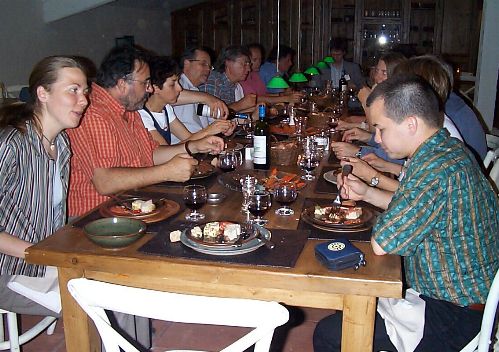
Following a long drive and an informative tour
round the Tour du Valat facilities, the Tour du Valat laid on
a superb Friday evening dinner in a fledgling "bio-restaurant"
in a restored traditional Camarguian set of farm buildings, over
seven hundred courses of really interesting-looking things (with
eggplants and bull sausages, etc.) that needed continuous commentary
from the managers.
Photo: Inga Racinska and Marco Flores of Ramsar,
closest to the digicam, and Dr Jean-Paul Taris, who arranged the
happy occasion, seeking second helpings farther down the table.
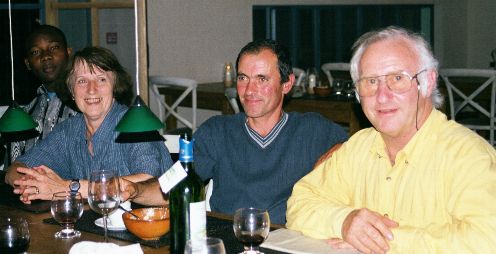
At the second table, Ramsar's Annette Keller entertains
Tour du Valat folks, particularly Alan Johnson, the flamingo expert
on the right who subsequently (Saturday) explained the whole thing
about successfully building fake nesting islands to bring the
flamingos back and what not.
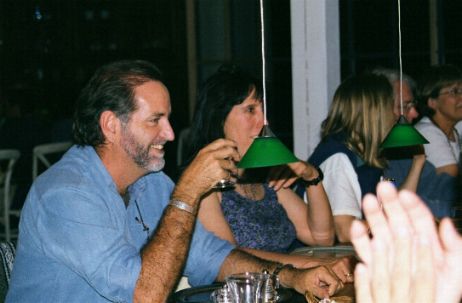
Dr Max Finlayson of the Environmental Research
Institute of the Supervising Scientist (the what?!?) in Australia,
who is sometimes referred to as Ramsar's "science engine",
and who happened to be -- happened to be?? -- residing at the
Tour du Valat at the time (reading over his agenda papers for
the 10th meeting of the Ramsar STRP in Switzerland, and preparing
his rebuttals), seen with Lisa Durham and (turned away) Ammy Gillesberg
at the traditional bio-dinner.
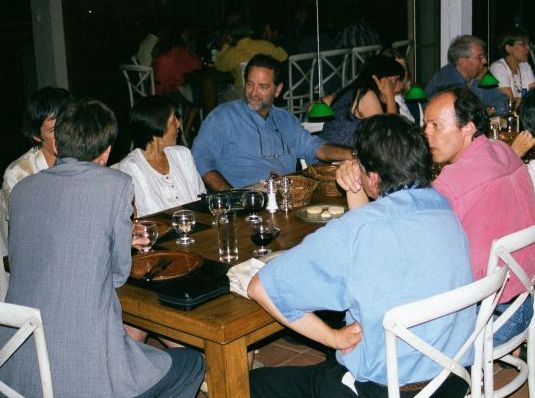
Sandra Hails (Ramsar) hectoring Max Finlayson
about wetland functions and values, relative to bull sausages
in the Camargue; Tour du Valat's Jean Jalbert in the reddish shirt.
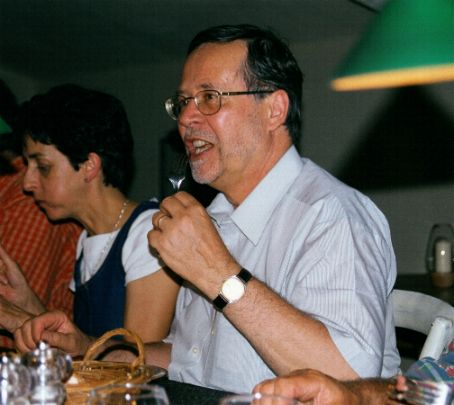
Ramsar's Secretary General tries out traditional
Camargue bio-specialities energetically.
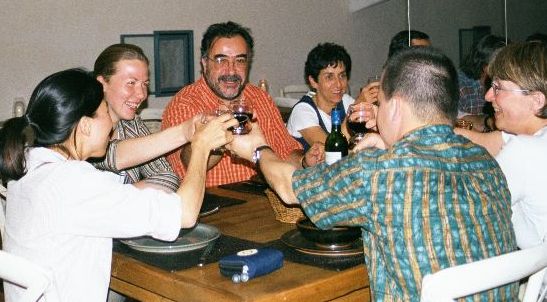
Tour du Valat director Jean-Paul Taris toasts Ramsar
interns in an extremely welcoming and hospitable manner.
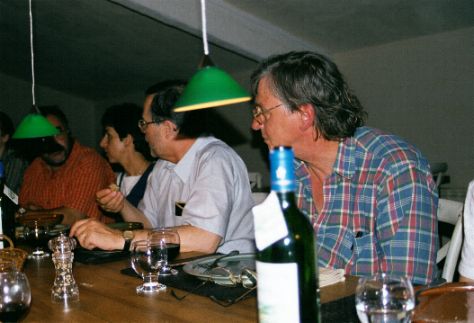
Watching, incredulous, as people try to eat bull
sausages down at the end of the table, after all the eggplant
quiche and asparagus nibbles and broccoli tarts and Great Big
Lamb Chops.
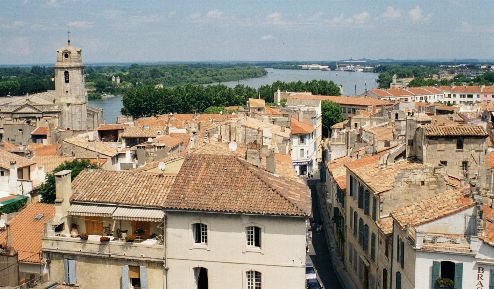
Saturday morning, a view of Arles from the amphitheatre
(Photo: Sandra Hails)
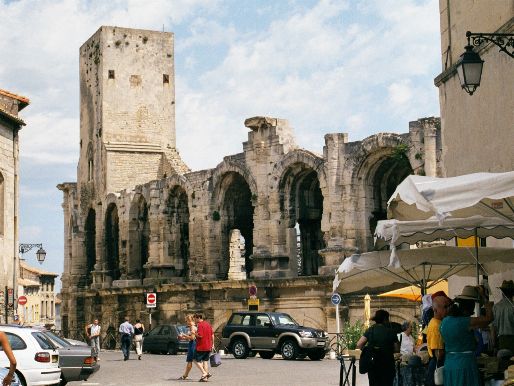
The amphitheatre in Arles, photographed by Sandra
whilst planning lunch.
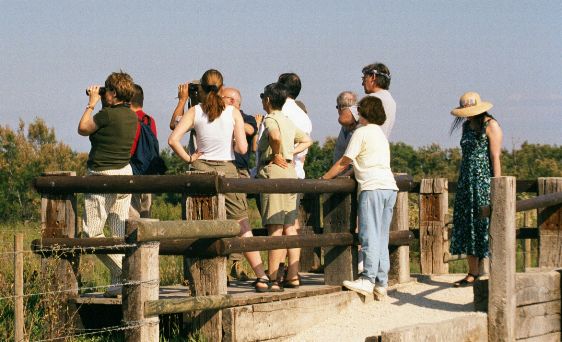
Ramsar Bureau staff, recalling the Convention's
origins in waterbird conservation, seek flamingos. The lady on
the right is doing pre-Raphaelite instead.
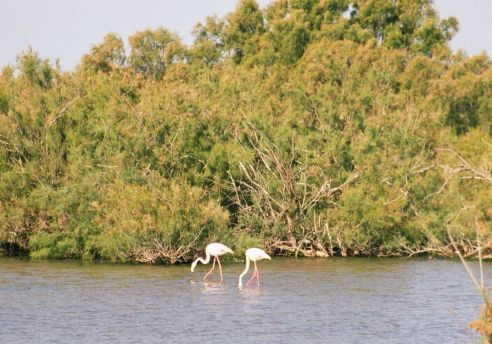
Whoops, there are the flamingos, just as promised.
Standing there in the water, looking downwards. With some purpose
in view no doubt. (Might make great mine detectors perhaps.)
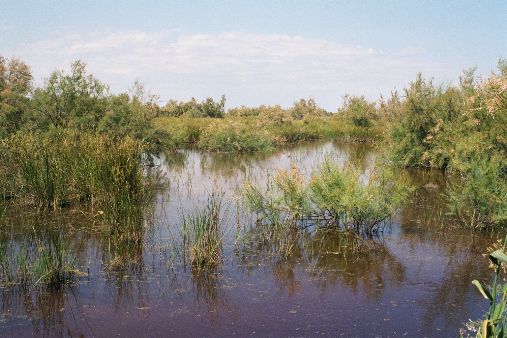
Here's the obligatory generic wetland shot: "Camargue,
France (Photo: Sandra Hails)"
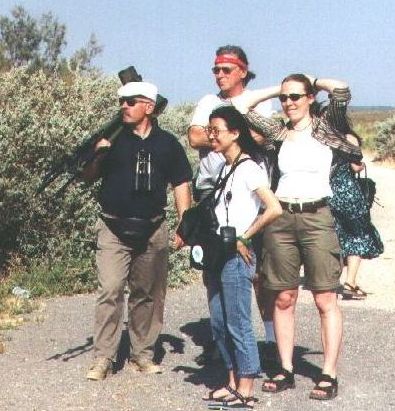
Very serious bird watching in prospect: Ramsar
knows how to focus its efforts singlemindedly until the goal
has been achieved. In this case, however, the birds had already
moved on, so the gear went back into the car, and so did staff.
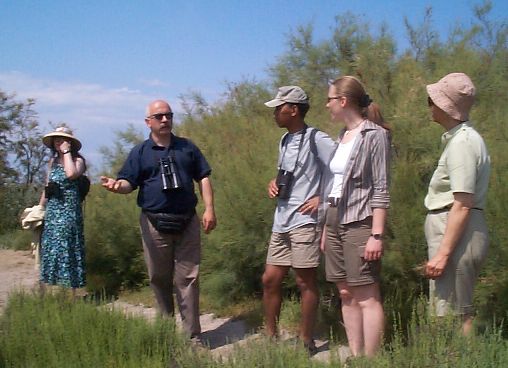
Tobias Salathé, an extraordinary teacher,
leads the walk round the La Capelière nature reserve in
the Camargue and pauses frequently to explain all the nuances
about both the wildlife and the management techniques being employed.
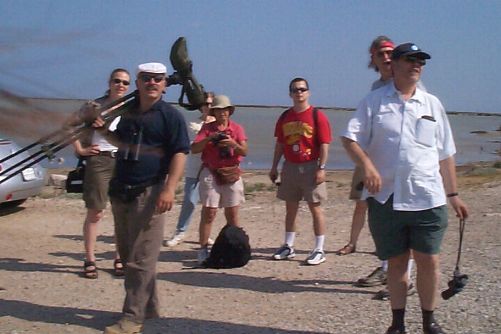
Ramsar UFO-Watchers hoping that this one will
be the Big One. Enough of those grainy cigar photos -- with this
equipment we ought to be able to get the definitive story on alien
invasive species from outer space. (On this occasion, though,
they landed, checked us out for a few moments, and then left again.)

Way out on some force-fed salines, which took
most of the life out of our automobiles' shock absorbers, Dr Salathé
refers to a map in an effort to explain why all the birds are
off nesting and feeding their young and occupying their time with
canasta at some other place, but not here, until next Tuesday.
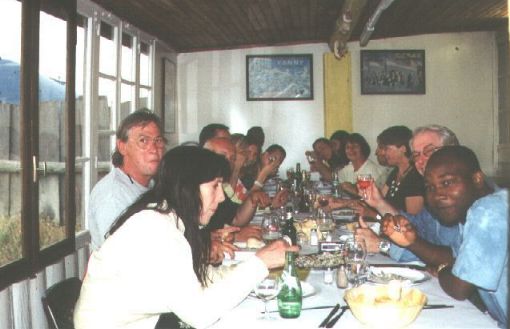
An extremely tasty dinner in a semi-ramshackle
fresh seafood restaurant serving traditional Camargue specialities,
apparently semi-legally, where Ramsar staff and like-minded wetland
enthusiasts chewed and swilled until a fire broke out in nearby
caravans and everybody could think of some other peninsula they'd
rather be on soon.
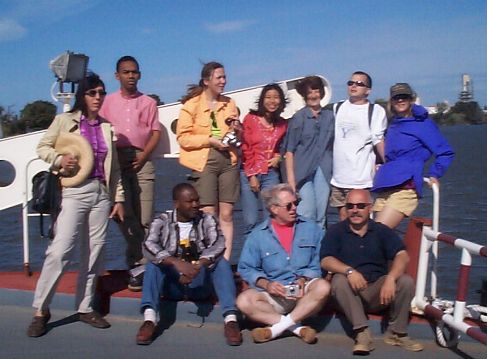
Sunday morning: ferry across the Rhône,
Ramsar staff and friends making like this is some big deal, crossing
a river, oh wow.
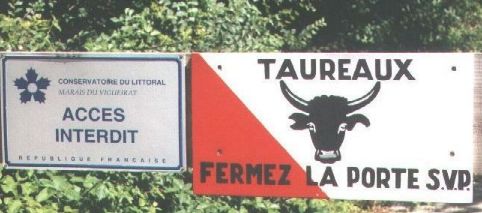
A Sunday visit to the Marais de Vigueirat protected
area on the eastern side of the Rhône -- it begins somewhat
ominously: "BULLS, close the gate please"!!
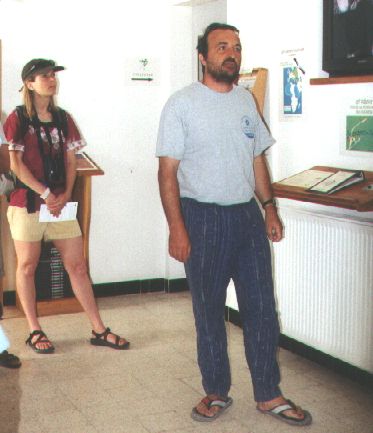
The Marais de Vigueirat boasts superb wetland
education facilities, and Jean-Laurent Lucchesi demonstrates the
electronic Webcam facilities (teensy cameras out there in the
nests, you can watch them hatch while standing right here next
to the Coke machine) and leads the Bureau staff on a tour of the
educational learn-by-doing nature path through part of the wetland.
Ammy Gillesberg, Ramsar friend from IUCN, left.
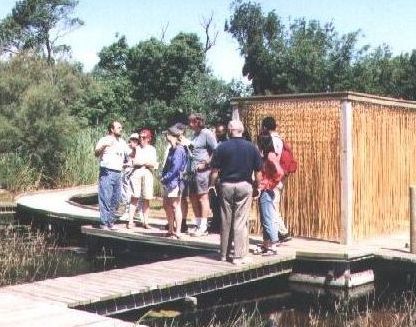
This display is meant to let you experience what
it's like to part reeds in a swamp. Well, okay. Some of the other
interactive stations seem to reach more deeply into our daily
lives than that one does.
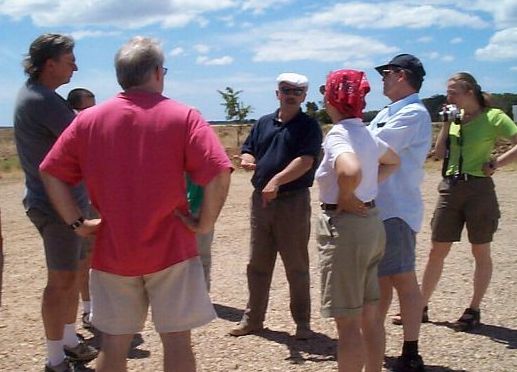
Time to go home. Dr Salathe explains the complex
management situation at the Crau Mediterranean steppe area above
the Camargue, then leads us all along to Les Baux medieval tourist
village and a restorative pause whilst Dr Keith Kennedy (pink
shirt) finessed some fine wine purchases, and then a tortuous
circuit out onto the French autoroute for a thunderstorm-filled
trip home to Geneva. Exceptional weekend all the way round.
We've also got lots of tourist photos of the famous
Camargue white horses, and of course plenty of shots of the famous
bulls, and gazillions more of those flamingos looking morosely
down hoping dinner will wander along without noticing all the
looming flamingos. Hundreds of megabytes worth, but bandwidth
problems intervene, so the Ramsar public will have to be content
with what's here. In any case, Camargue white horses look like
white horses, so we wouldn't be helping you out very much by putting
them up here.

 For
further information about the Convention on Wetlands, please contact
the Ramsar Convention Bureau, Rue Mauverney 28,
CH-1196 Gland, Switzerland (tel +41 22 999 0170, fax +41 22 999
0169, e-mail For
further information about the Convention on Wetlands, please contact
the Ramsar Convention Bureau, Rue Mauverney 28,
CH-1196 Gland, Switzerland (tel +41 22 999 0170, fax +41 22 999
0169, e-mail  ).
Posted 11 July 2001, Dwight Peck, Ramsar. ).
Posted 11 July 2001, Dwight Peck, Ramsar.
|